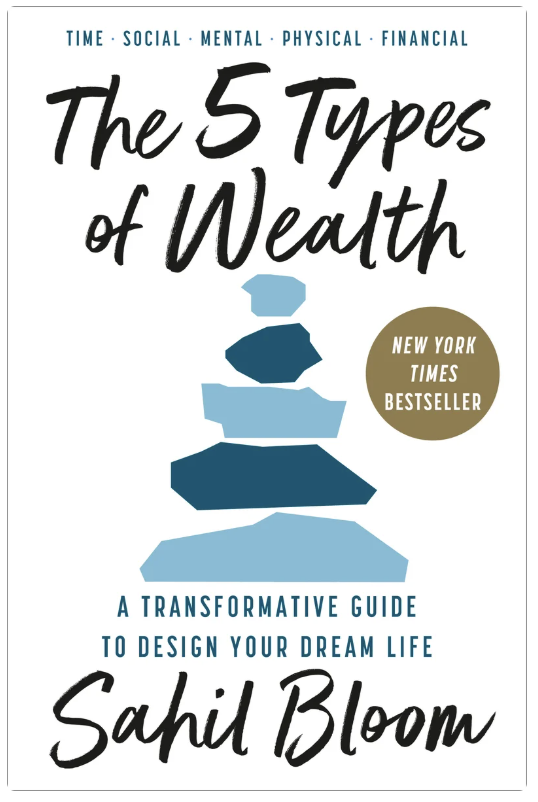
In the United States, we have a culture obsessed with money. Many of us optimize for money and hard work, often at the expense of our families, personal growth, and health. Only after we’ve spent decades accumulating money do we realize that we’ve let the other areas of our lives languish. According to Sahil Bloom, author of The 5 Types of Wealth: A Transformative Guide to Design Your Dream Life, the top 10 richest people in the world have a total of 12 divorces between them. Most people hear the word “wealth” and immediately think of a bank balance. Bloom’s core mission in this book is to break that singular focus. He argues that by obsessing over money, we often bankrupt ourselves in the areas that actually make life worth living.
The 5 Pillars of Wealth
Bloom breaks down a truly “wealthy” life into five distinct categories.
- Time Wealth: The freedom to choose how you spend your day. Bloom emphasizes that time is our only non-renewable resource.
- Social Wealth: The quality of your relationships. This includes family, deep friendships, and your professional network.
- Physical Wealth: Your health and vitality. Without this, you cannot enjoy any of the other four types of wealth.
- Mental Wealth: Peace of mind, presence, and the ability to learn and grow.
- Financial Wealth: The traditional definition of money and assets. Bloom doesn’t dismiss finances, he simply urges us to balance our financial wealth the other four.
I personally love that he starts with “Time Wealth” as time really is the one thing you can’t get back. At one point he poses the question of whether you would trade places with Warren Buffet, who has $130 billion, but is in his 90’s. Of course you wouldn’t, because you’d rather have more time than all the money in the world, right?
Key Overarching Takeaways
There were a couple of main themes that popped up throughout the book.
The “Wealth Paradox”
One of the most profound sections of the book discusses how we often trade our Time, Social, and Physical wealth in exchange for Financial wealth, hoping to “buy back” the first three later in life. Bloom argues that this trade is often a bad deal because you can’t buy back your youth or the years your children were small. He’s, of course, right about that.
The Power of “Enough”
Bloom challenges the “more” culture. He provides frameworks for identifying what’s enough for you, which is the level of financial wealth required to sustain your desired lifestyle across the other four pillars. He’s clearly a part of the financial independence community and he does a great job of explaining how to become financially independent, right down to some pretty good descriptions of why compound interest is so powerful.
Practical Ideas to Design Your Life
This book is absolutely full of life hack-type pieces of advice. At times, it seemed that Bloom was trying really hard to put all of the various pieces of advice he’s ever heard or used together in some coherent way. It can get overwhelming, but his practical ideas are also very useful. I can vouch for many of them as I’ve tried them myself. He does discuss some unique ideas. For example, Bloom offers actionable “Wealth Audits” at the end of chapters to help you score yourself in each category and identify where you are currently “bankrupt” so you can use some of the actionable tips to better balance your life.
Who Should Read This?
Anyone with an interest in financial independence and life optimization will like this book. There are a few others who I think will really benefit from reading The 5 Types of Wealth.
- The Overachiever: If you’re burning the candle at both ends and wondering why you aren’t happy despite a rising salary.
- The Early-Career Professional: To set a foundation for success that won’t lead to burnout at age 40.
- Anyone Feeling “Stuck”: If you feel like you have “everything” but still feel empty, this book will help you identify which pillar is missing.
Final Verdict
I’m honestly not sure that I learned many new things in this book. Bloom seems to be repackaging a lot of self-help common knowledge (the energy calendar, the Eisenhower Matrix, various breathing exercises), but he does it really well. The 5 Types of Wealth is a refreshing antidote to the “hustle at all costs” culture. It’s well-structured, easy to read, and deeply practical. It’s not just a book about money; it’s a blueprint for a life well-lived. So, if that’s your thing and you want to be inspired to live a better life, this book just might be for you!